






And what to do instead.
You’re an owner or owner’s representative.
You’ve assembled a solid design team.
The drawings go out for pricing.
Then the numbers come back…
…and they’re not even in the same zip code as your budget.
This moment is more common than anyone likes to admit. And how you respond next will either save the project—or quietly set it on a path of delays, frustration, and wasted money.
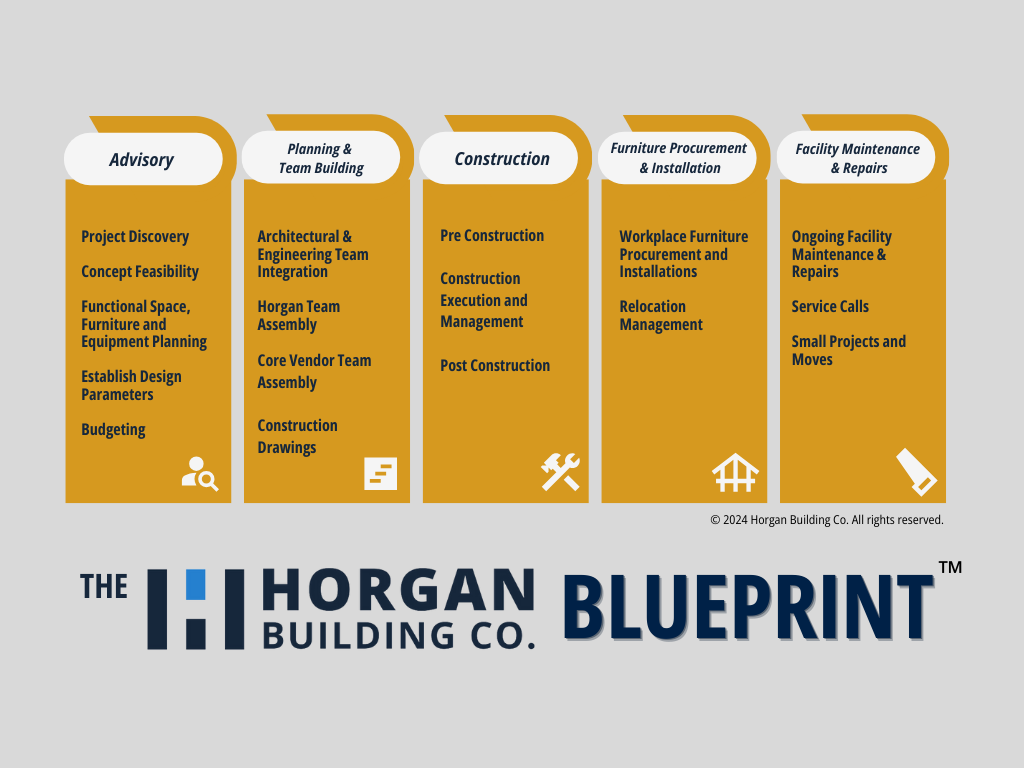
Here are three things not to do when a project comes back over budget….and how Horgan’s proven project blueprint actually works:
Don’t Redesign the Project in a Vacuum

The instinctive reaction is often:
“Design team, go sharpen your pencils and bring this down.”
That sounds reasonable. It’s also risky.
In many cases, cost was not a primary design driver in the early phases. That’s not a failure, it’s just reality. Architects and engineers are trained to solve spatial, functional, and technical problems. If real-time construction costs weren’t part of the initial design conversation, sending that same team back alone makes the redesign more of an educated guess.
What usually happens?
- Scope shifts without real savings
- Materials get swapped without constructability input
- Systems get tweaked, then tweaked again
And somehow… the project is still over budget.
Designing without current cost intelligence isn’t value engineering. It’s being redesigned blindfolded.
Don’t Get Trapped in Endless Redesign → Reprice Loops
This is the silent killer of schedules.
A revision goes out.
It gets priced.
It’s still over budget.
So another revision goes out.
Repeat this cycle a few times, and you’ve accomplished three things:
- Burned weeks (or months) of the schedule
- Increased design fees
- Frustrated everyone involved
What you haven’t done is fundamentally realigned the project with the budget.
Repricing repeatedly feels productive because something is “happening,” but activity is not progress. Without a clear cost target and a coordinated strategy, this loop just creates motion without resolution.
Worse, by the time construction finally starts, the team is exhausted—and trust is already eroded.
Don’t Treat Cost Control as a Late-Stage Panic Button

Value engineering should not be a last-minute scramble to “cut things.”
True cost control is not about stripping quality or making arbitrary reductions. It’s about understanding:
- What actually drives cost
- Where flexibility exists
- What trade-offs matter—and which don’t
When VE is done late, it often turns reactive:
- “Can we delete this?”
- “What if we downgrade that?”
- “Can this just be cheaper?”
That approach almost always results in compromises no one is happy with and a design that works for the budget and not for you.
What You Should Do Instead
Bring the GC to the Table—Early

If a project is meaningfully over budget, the most effective move is to bring a qualified General Contractor into the conversation early, not just to price, but to collaborate.
Horgan brings:
- Real-time cost data
- Constructability insight
- Trade partner perspective
- Schedule awareness
- Practical sequencing strategies
Our expertise answers the questions that matter:
- What changes save money versus just shifting it?
- Where is the design overbuilt for the intended use?
- What actually moves the needle on cost?
- What scope elements are driving complexity?
This isn’t about handing control to the contractor. It’s about aligning all available expertise to make informed decisions.
Think Target Value Design, Not Traditional VE
Our goal isn’t to “design it and then cut it down.”
Our goal is to design for a known target.
Target Value Design flips the mindset:
- Budget becomes a design parameter, not an afterthought
- Cost, scope, and constructability are discussed together
- Decisions are evaluated against a clear financial target
Instead of asking, “How do we cut this?”
You ask, “How do we achieve this outcome within this budget?”
That shift alone changes the entire tone of the process.
Collaboration Beats Correction…..Every Time
Projects don’t go over budget because people don’t care or aren’t trying hard enough.
They go over budget because:
- Cost, design, and construction weren’t aligned early
- Decisions were made without full information
- Teams worked sequentially instead of collaboratively
The fix is rarely more revisions.
It’s better alignment.